Tarot cards are fascinating. That is why there are hundreds and hundreds of different Tarot decks. Each Tarot deck expresses a unique creative impulse, and each card in each deck has an energy that is all of its own.
As a collector of Tarot decks I have been awed by the boundless creativity of the spirit of Tarot. As I read the Tarot cards, I have been likewise awed by the Tarot’s power to generate insights. By trying out different decks I have discovered that every Tarot card there is has the ability reveal a secret that no other card could. I have discovered that there are no duplicates in this universe of ours.
I like to read one card at a time, and I never use the same deck two days running. In this way I get a surprise every time I pick up a card to read. Every image is new to me. Every reading enriches me with the gift of some understanding or perception that I didn’t have before. The Tarot has taught me that everything in our universe springs from an inhaustible source of originality. Our universe will never run out of ideas.
It is time for me to share some of my delight with others. Perhaps I can give back to All That Is a little bit of what All That Is has given me. I can only try.
What better place to start than with the card of infinite possibility? The first card of the major arcana is numbered zero, but really it should be numbered ∞. “Zero” implies static nothingness. The Fool archetype is exactly the opposite: dynamic and full of limitless potential.
Learning the practice of Tarot often starts with learning the card archetypes. When I say “archetype” I mean a generic abstraction of the idea symbolised by the card. As an example, here is one definition of the generic meaning of The Fool archetype:
“The Fool represents new beginnings, having faith in the future, being inexperienced, not knowing what to expect, having beginner’s luck, improvisation and believing in the universe.” – Wikipedia
Sometimes, unfortunately, the beginner is presented with a list of predictive meanings instead of abstract ideas. I say “unfortunately” because such an approach causes the Tarot to be caricatured as just a fortune-telling gimmick in the eyes of the world. Here is an especially bad example of The Fool being interpreted predictively:
“The Fool is a good omen if you’re single and want a relationship. It can predict that you will be swept up by someone who is exciting and carefree. They will be fun to be around and the relationship will feel like an adventure. The Fool is not desirable if you’re looking for something more serious. This card can represent someone with a childish predisposition coming into your life.” – Divination and Fortune Telling by Lisa Boswell
A list of interpretive keywords is a good starting place, but the real excitement starts when the archetype is physically embodied in a graphic on a piece of cardboard. That’s when the card transforms itself into your own, personal, intimate guide, with a message that is perfect for just you, just here, just now.
That’s exactly the experience that I head when I read one particular card in December 2015. I am going to share that experience in this blog, in the hope that you will share my sense of wonder at how one card unfolded in my imagination into a moment of profound insight that a whole book could not have imparted. The card was The Fool, of course, but in a guise specific to the Tarot deck that he came from. In my next post I will tell you all about him.
The Tarot card that I am going to explore in this post is called The
Seeker. He is the figure that corresponds to The Fool in the Arthurian
Tarot.
Here is a picture of my copy of the Arthurian Tarot: rather old and
battered, as you can see. The deck has since been re-published in a new
packaging. You can read detailed reviews of the Arthurian tarot here, on the Aeclectic Tarot site, the ultimate destination on the internet for all lovers of Tarot decks.
Here is the Seeker himself. I see a young man with his feet on a rainbow bridge, setting out to explore a very big world.
To me a Tarot card is a gateway that I can go through to enter a different world. It is like Alice going through the looking glass. This card, like all the cards in the Arthurian Tarot deck, actually depicts a handy archway for the reader to walk through.
Some things in the picture jump out at me. The rainbow bridge, for starters. The rainbow is rather a trite symbol in itself. I understand that the Seeker’s soul is emerging, as all souls do, out of the realm of pure potential into the realm of manifestation, much like Schrödinger’s cat. But there is something else.
There is a special jolt that you get when you realise that the Tarot knows a secret about you that no-one else knows. My secret is – or was, now that I am revealing it – that I use a rainbow visualization to centre myself before reading a Tarot card. The Tarot does this to you sometimes. It searches your soul. I have learned that you had better not try to read a Tarot card unless you are prepared to be read in return.
So now I know for sure that the Seeker is me, other parts of the image come into focus. Whatever the Seeker is seeking, there is a very long road to walk. The path winds into the far distance in both directions. The Seeker has to go one way or the other. He has not yet chosen. Which way to the destination that he seeks? Left? Or right?
Paths are funny things. Do they ever lead to a final destination? All paths meet up. You can walk off into the sunrise and return out of the sunset without ever turning around. The conclusion is a truism: the journey is the destination. The present moment is all we have. Enlightenment is in the here and now.
Hardly a new idea, I realise. I am disappointed. The Tarot hasn’t told me anything I didn’t know already. Then… a new understanding dawns.
This card is called The Seeker, not The Aimless Wanderer. The Seeker is on a quest. It might be the quest for the holy grail, for all I know, but it really doesn’t matter what this seeker is seeking. The point is that a quest is never undertaken for the benefit of the quester. In fact, the opposite. The quester risks everything, even death, to find what must be found to bring about the healing of the world. Quests are dangerous missions to go on, not pleasant strolls into personal fulfillment.
A Tarot reading is nothing unless it has a positive and practical conclusion. In this case, the outcome is that my attitude to enlightenment has been changed.
Maybe it’s not all about me. Maybe it’s about love.
Sometimes even the infinite Tarot repeats itself. Or does it? On very rare occasions I draw a repeat card. It doesn’t matter. It may be the same card, but I am not the same reader as before. There is always some fresh information to be found in the card. The amazing thing is that the new reading is always consistent with the previous reading. My experience is that the second reading expands on the first one. The Tarot stays true to itself.
A good example of what I mean is the following two readings of the King of Wands card from the Golden Tarot by Kat Black which I would like to share with you. You can read reviews of this lovely Tarot deck on the Aeclectic Tarot site at this link. Each card is a collage of many different elements digitally extracted out of late medieval and Renaissance artworks. Each image is richly textured and visually stunning – and each one radiates that mood of deep stillness that the Tarot is so good at inducing.
The first time that this card came up for me was in December 2015. This is what I wrote in my journal at the time.
Heat. Baking, sweltering heat. The blazing fire, the thick tapestry, the king’s heavy robes make the heat unbearable. Suffocating heat. The King of Wands tells me that his function is to translate the infinite heat energy of the Big Bang into organic life. The paradox is that the original element of the universe, fire, is destructive of life, and yet all life emerged from it. The King of Wands is like a blacksmith working a forge: he forms objects out of the furnace. He is a buffer between the unbearable intensity of primal energy and the material universe. He prevents the physical creation from being burned up by its own source. He protects us from the full force of God.
In April 2016 I drew the King of Wands from the Golden Tarot again. I wrote:
The last time I looked at this card I felt heat. This time, I look into the king’s face. He begins to take on symbolic dimensions. I feel in him a moral flame. Swords are coldly intelligent, Cups are all emotional and Pentacles practical and worldly. It is the Wands which represent the waking of the passion of the striving human spirit. In the King of Wands I see the force for good which has been working unseen through the history of civilisation. We have become more civilised beings through the centuries, despite our many setbacks and failings and the force for evil which has tried to drag us back. I am sensing a passion for refinement and what is right: that Camelot moment when might is not right and we honour our noblest ideals. I sense thousands of years of small, good things happening. Millions of lines of poetry have been written and read, uncountable little acts of kindness and honesty have been performed. Human beings have endured unspeakable suffering and survived unimaginable hardship without growing bitter, still believing in God and standing up for justice. The King of Wands encapsulates the unstoppable progress of mankind from animal to human to… whatever it is that we may become.
Although the first reading was all about having a mystical, metaphysical experience, and the second reading was a meditation on human potential, the two readings are related. In the first reading I found myself in the presence of primal energy itself, but in the second reading I saw how that primal energy drives mankind’s forward progress here on earth. It is exactly as the King said in the first reading: our physical reality is formed from the same stuff as divine reality. There is no reason for us to feel any different from God.
The “Waking the Wild Spirit” Tarot deck by Poppy Palin is a colourful, light-hearted deck with a whimsical pagan slant. It is reviewed in depth at this link on the Aeclectic Tarot site. Unfortunately, it is out of print now. A few copies are still available to buy new directly from the author at this link. It has become a bit of a collector’s item, it seems.
The spirit of Tarot is not above poking some fun at the card reader, as I discovered when I pulled The Fortune Teller in January 2016. The Fortune Teller corresponds to the Page of Cups in traditional Tarot decks. Here is my journal entry from the time.
“There is something perverse in the Tarot giving a Tarot reader a picture of a Tarot reader. I stared at the card blankly for ages, trying to find a deep significance in it, getting frustrated. Then I realised that it was just the Tarot’s warped sense of humour telling me to lighten up.”
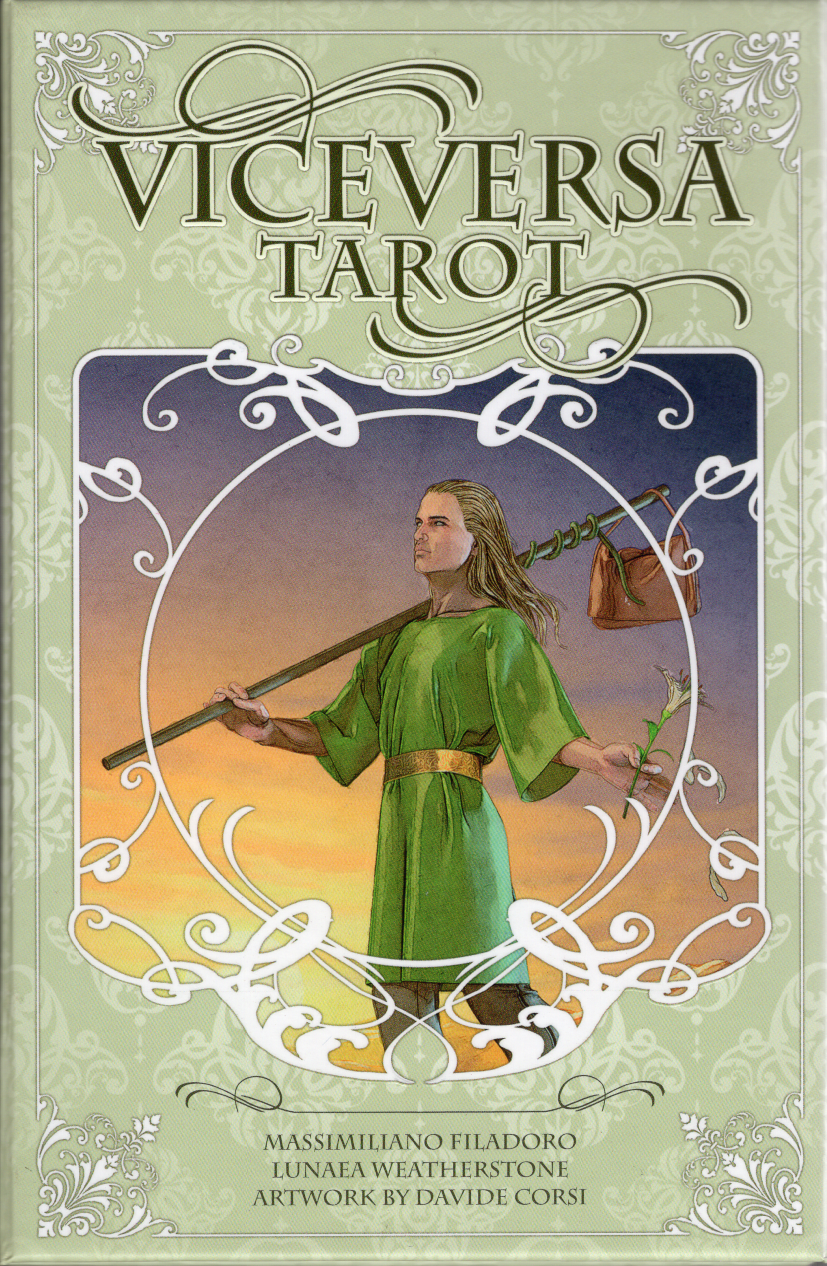
I don’t use reversed cards in Tarot readings. One reason is that pictures make no sense when they are upside down. Another reason is that the given meaning of a reversed card in Tarot lore is often just a negative flip of the more positive upright meaning. Binary thinking like that doesn’t do justice to the subtle gradations of the reality that we live in. I also don’t like the simplistic assumption that there are Good things and Bad things. Everything there is has the weakness of its strength and vice versa. Which brings me to the subject of a remarkable new Tarot deck, the Vice-Versa Tarot.
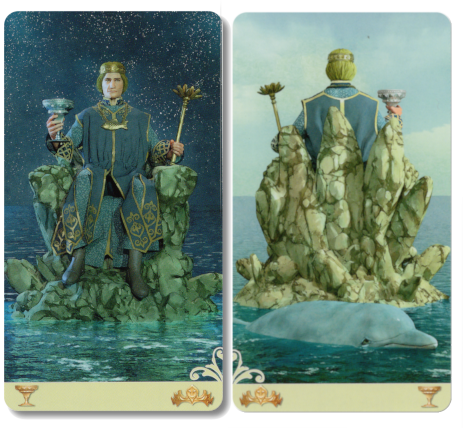
You couldn’t ask for a more impressive presentation. The cards come in a sturdy cardboard box with a magnetic catch on the opening. Moreover they are accompanied by a lavish square-bound companion book printed entirely on thick, glossy paper. The thing about the Vice-Versa Tarot is that the cards are double-sided. There are two complementary images for each of the standard 78 cards in a Tarot deck. Which image is the “upright” one and which image is the “reversed” one? You decide. There is no binary thinking here. This is a 3D world.
I’m sharing this particular reading of a card from the Vice-Versa Tarot deck because it is an excellent example of how economical the Tarot can be with its symbols. The Tarot can convey a whole volume of meaning with just one tiny object. It is also an example of how a Tarot card doesn’t have to have an elaborate verbal interpretation. It may just dip you into a brief sensory experience that is out of time and out of mind, as it did on this occasion.
The card that came up for me was the King of Chalices from the Vice-Versa Tarot deck.
My attention is caught by the chalice in the King’s right hand. Chalice…grail…blood of Christ. But this chalice doesn’t contain blood, I realise. It contains the purest, freshest, coldest spring water! I am so thirsty. How I long for that ice cold drink of water here, now, on this hot afternoon. I can almost taste it… In fact, I discover that I have tasted it in my imagination. The card reading has given me a moment of spiritual refreshment that lightens my whole day. The Tarot blessed me in passing.
OK, so this reading is a bit personal. I thought hard about whether I should share it or not. In the end I decided to go ahead and share it. The final message will not be news to anyone who is married. In fact, it’s a message that married people need to hear often.
The reason why I specially wanted to share this reading is that it is a good example of what this amazing Tarot deck can do. The Fairytale Tarot is not only a deck of 78 exquisitely drawn illustrations. It is also a collection of 78 fairy tales and folk stories from all over the world. The stories are beautifully retold in the substantial book that accompanies the deck. By some strange alchemy each story is perfectly attuned to the traditional meaning of its associated card in such a way as to illuminate hidden depths in the card’s interpretation. Nothing can get a wake-up call to a person the way a story can.
The context of this reading, which happened at the end of 2015, was a bit of marital discord. I can’t remember what it was about now, but I know that I was highly irritated and knew for a fact that it was all my husband’s fault for being inconsiderate and wrong-headed. I turned to my beloved Tarot for comfort. This is the card that came up for me – the Seven of Swords and the story of the Frog Prince.
The Seven of Swords is one of the few nasty cards in the Tarot deck. There can be spite in it, and deviousness and deceit. I have discovered that the Tarot can be very frank when it speaks to you. It will call a spade a spade. But it will always do so in the spirit of encouraging you to be a better person. I am happy to say that the Tarot was very gentle with me that night. It seems that I had only earned a mild reproof.
The story of the princess and the frog is a well known one. It’s the original story about kissing a frog to catch a prince. In this illustration the frog is explaining to the princess that he is really a prince under an enchantment. Only love can save him. This is what I wrote in my journal at the time:
“Princess meets frog. The frog wants to be transformed back into human form. The thing is, the frog is not the only one in need of transformation. The princess badly needs a makeover too. She is rather a selfish little brat. The frog is, in fact, the more evolved of the two, because he is actually a wise, mature being under the ugly disguise. He is trying to be the best that he can be. He will take the princess in hand and make a beautiful, graceful, serene and kind woman out of her, simply by releasing her inner self with his love. She too will become all that she can be, through the magic of the devoted love of another human being. The message to me is to realise that my husband isn’t the only one who needs to change.”
It started off, as it always does, with reading one card. It ended up as a dissertation on the creative tension between paganism and Christianity in the course of two millenia of history in the western world. Tarot can do this to a person.
The Tarot is a kind of infinity box. It may look as if it has fixed dimensions on the outside – 78 cards – but its interior storage is unlimited. The Tarot is the Mary Poppins carpet bag of the western mystery tradition. Let me explain.
In our western culture we have been fortunate to have inherited an abundance of esoteric mystical systems. The Big Three, to my mind, are the Tarot, astrology and the Kabbalah. A lifetime of devotion to studying the symbological subtlety of any one of them would not be enough to grasp the profundity of the wisdom concealed in each. But there are more riches still.
Our earliest spiritual roots are grounded in the Goddess cults and fertility cults which date back to the Stone Age. Their primal religious impulse is still deeply encoded in the cultural DNA of the western psyche. Their latter-day descendents are the codified earth religions like Druidry and Wicca.
Mythology is an endless source of living archetypes to feed the ever-renewing imagination. We have been fortunate enough to have been handed down not only the Greek and Roman bodies of mythology but also the stories of the Norse gods and goddesses in the Icelandic Edda. Celtic and European folklore have added a distinctive flavour to the primal broth of the imagination that our modern souls swim in. The legends of Merlin and Arthur alone have proved to be a source of endless creative inspiration for seekers of the truth in the European tradition. And to all of this priceless legacy we must add the other half of our spiritual heritage: the Judeo-Christian worldview that contains everything from Eden to Armageddon. You might say that we western seekers have got more esoteric material on our plates than we can well digest.
The protean Tarot has succeeded better than any other of the thought systems I have mentioned to reach out and make connections between them. Tarot is infinitely adaptable. We have got hundreds of Tarot decks that explore different aspects of western esotericism. The theme may be herbs or animals, Shakespeare or fairy tales, but somehow each Tarot deck takes one facet of the confusing mass that is western symbology and organizes it around the 78-card template. In this way patterns emerge and cross-references can be made. Resonances are built up. As I see it, Tarot is the combined Dewey Decimal System and Rosetta Stone of the western mystery tradition.
In my next two posts I will show you this effect in action.
Tarot meets Camelot. This deck composed of exquisite watercolour illustrations by Anna-Marie Ferguson perfectly captures the romance of chivalry as it was imagined in Le Mort d’Arthur by Sir Thomas Malory.
This is the kind of Tarot deck that a call a heavyweight deck. It is literally heavy, because it comes with a full-sized book entitled A Keeper of Words. I love the physical sensation of lifting a hefty presentation box off the bookshelf. It is also a heavyweight contribution to the Tarot genre because it joins two foundational mythologies – Tarot and the Matter of Britain – into an original synergy in such a way that each illuminates the other. This is a deep deck and no mistake.
In my previous post I discussed Tarot’s ability to cross over the boundaries between apparently unrelated esoteric realms. The Legend Tarot is a prime example of this crossover effect. Two paradigms melt into one. The logical structure of Tarot and the fluidity of the Arthurian narrative magically blend into an alchemical fusion of complementary opposites. As always happens when opposites synthesize, an utterly new way of being is born out of the union.
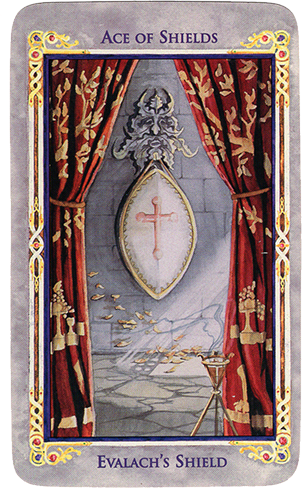
I know this because a major schism in my life was healed by a reading of just one card from the Legend Tarot deck. Here is the card.
(In the Legend Tarot the Shield suit corresponds to the suit of Pentacles in a classic deck.)
There is a long story behind this card. I will quote it in full from The Keeper of Words.
“In the Grail romances, Evalach the Unknown was the heathen king of Sarras. He was befriended by Joseph of Arimathea who found Evalach enthroned in a rich sun temple within the city of Sarras. Joseph eventually managed to convert Evalach to the Christian faith, though judging by his baptismal name, Mordrain (‘slow of belief”), one might guess that this was not an easy task.
Joseph gave his friend a shield of miraculous powers, which depicted the scene of the crucifixion. Evalach carried the shield into battle with the Egyptian king Tholomer. The sight unnerved his opponents and brought victory to Evalach. After the battle, the shield performed a second miracle by restoring a soldier’s severed hand; the scene on the shield faded, never to return.
Joseph of Arimathea made his way to Britain, reputedly bringing with him the Grail, or chalice of the Last Supper. Evalach followed, bringing the treasured shield into the future land of Arthur. Legend claims that the Holy Grail first came to rest in Avalon (Glastonbury). It was during this time that Evalach approached too near the Grail and was struck down. His dare left him a blind invalid, destined to languish in this world for hundreds of years, until Galahad released him. While upon his deathbed Joseph thought to leave his earthbound friend something to remember him by, and stained Evalach’s shield with a cross of his own blood.
Evalach established an abbey and placed the shield in its care. Over the years rumours circulated, attracting knights who tried and failed to bear the shield. None could ride more than a few miles from the abbey without being assaulted by a phantom white knight who insisted the shield be returned. Thus, when Galahad arrived at the abbey, the shield of Evalach awaited him. On leaving the abbey, bearing the shield, Galahad met the white knight, only this time the phantom related the history of the shield and then vanished.
Evalach was healed by Galahad and died in Galahad’s arms.”
An evocative story out of the mists of legend, but what did it have to do with my existential problems in the here and now? I will tell you in my next post.


 A good example of what I mean is the following two readings of the King of Wands card from the Golden Tarot by Kat Black which I would like to share with you. You can read reviews of this lovely Tarot deck on the Aeclectic Tarot site at